
Project
Linda Tegg (VIC) in Carnarvon
Below is a reproduction of the Welcome to Country presented at the Carnarvon Space and Technology Museum by Yinggarda woman Rennee Turner, March 2026.
My name is Rennee Turner, and I am a proud Yinggarda woman, Traditional Custodian of this Country. On Behalf of my Elders and my People, I welcome you here tonight. I welcome you to this place — the Country on which we gather — to our stories, and to our living culture.
And I want to say from the beginning…you are welcome here. For us, Country is not just something we stand on. Country is everything. It’s our teacher. It’s our library. It’s our law. It holds our history, our knowledge and our responsibility — and the connection has never been broken. When we speak about Country, we’re not just talking about land. We’re talking about a living system — where everything is connected. The plants, the animals, the tides, the winds, the night sky… and us as people.
Everything has a role.
Everything has a story.
Everything has something to teach.
But only if we take the time to listen.
And that’s something this exhibition really speaks to.
Because we are all gathered here tonight, inside this space…the work itself comes from time spent out on Country. From places like Bush Bay. When we went out to Bush Bay, this project wasn’t about creating something separate from Country. It was about being with it. There was no rush. No pressure. We just spent time on Country. We walked out onto those tidal flats. We worked with the seagrass. We watched the tides come in and change everything we had just done.
And that teaches you something straight away…
Nothing is fixed.
Nothing is separate.
Land, sea, sky — it’s all connected.
There was a moment out there that really stayed with me. I stood there with people, asking them to hold sand in their hands. To introduce themselves to Country. And then to give that sand back. Simple. But powerful. Because it wasn’t about taking anything.
It was about respect.
It was about understanding your place.
It was about beginning a connection.
And that’s something our people have always known. We don’t stand outside of Country. We are a part of it.
We belong to it. And with that comes responsibility.
To care for it.
To listen to it.
To protect it.
Even the sky above holds our stories. For thousands of years, our people have read the stars — for seasons, for movement, for life. Those skies aren’t empty to us. They carry knowledge. They carry identity.
And now, we see satellites moving through those same skies. Modern systems connecting the world. But it makes you think…
How do we move forward with those things — without losing what’s already here? And that’s where this work, this collaboration, really sits. Not in one place — but between places. Between Bush Bay and this space here tonight. Between old knowledge and new systems. Between slowing down… and a world that’s always moving fast. Between looking and really truly seeing. Because when you slow down — like we did at Bush Bay — something shifts.
You start to notice more.
You start to feel more.
You realise that the quietest places are full of life, full of meaning, full of responsibility. So tonight isn’t just about what you see on the walls. It’s about what you begin to notice. What you begin to feel. And how you choose to connect — even while standing here. Because the truth is — we are on Country, right now.
Every single one of us. The difference is how we choose to walk on it. So as you move through this exhibition tonight, I ask you to take your time. Notice small things. Sometimes it’s the quietest moments — the smallest details of Country — that teach us the most about connection and responsibility.
And when we pay attention in that way, we walk with respect — not just for Country…but for each other.
Respect is also equity. It’s, about making space and meeting each other on shared ground. And that’s where real connection begins. So tonight take that with you.
The feeling. The connection. The responsibility. Because the Country holds us all equally — what matters is how we choose to walk on it.
Welcome to Yinggarda Country.
Rennee Turner
Driving in and around Carnarvon, you occasionally look up and see The Dish. Installed on the only hill in the area and standing 30 meters tall, the radio antennae seems to appear out of nowhere—first on the horizon, then suddenly up close. The surrounding roads and landscape alternate between concealing and revealing it, making its presence always astonishing.
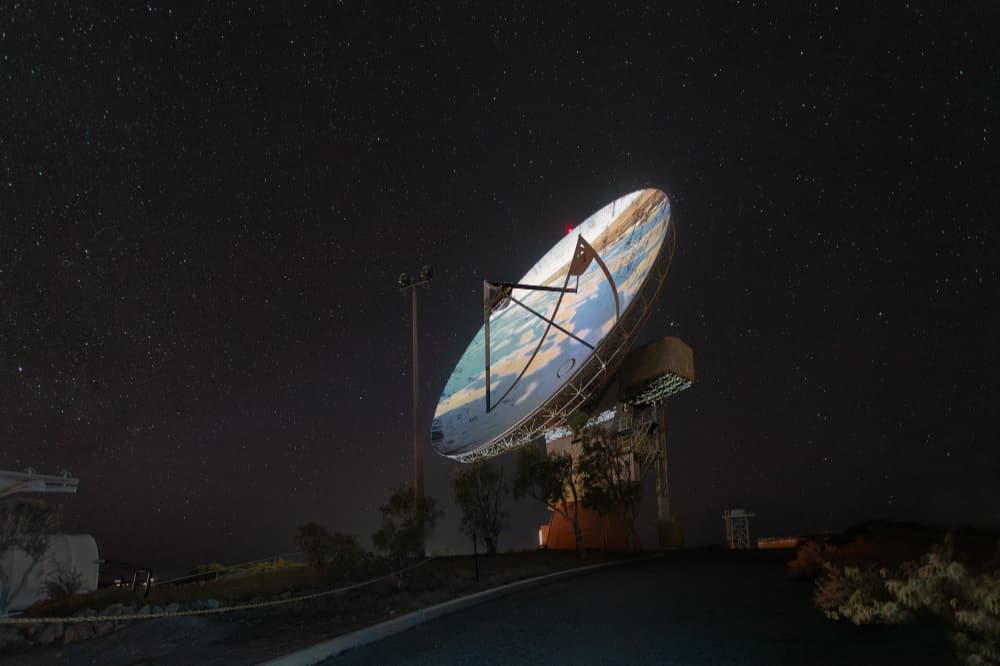
Decommissioned after tracking Halley’s Comet, the dish has recently been leased to a Canadian company named after the Egyptian god of intermediaries, Thoth. Thoth X is refurbishing the radio antennae for deployment in their Earth Fence situational awareness technology, which provides real-time data on space assets. Situational awareness services are becoming increasingly necessary as companies like Starlink and Amazon launch mega-constellations of satellites into low Earth orbit to provide global internet access. Starlink alone has plans to launch over 30,000 satellites in the next decade 1. Situational awareness can help prevent collisions.
Starlink’s satellites have a design life of five years and move predictably across the sky, bisecting our view of ancient constellations. First Nations astronomers Karlie Noon and Krystal de Napoli describe how, for over 65,000 years, the history of the Australian continent has been mapped in the sky, serving as a platform for knowledge. They explain, “For a culture with a deeply and intrinsically connected knowledge structure, the skies are the melting pot and reference point for much of this information. They are the stage upon which stories unfold” 2. Noon and de Napoli have identified the risks that mega-constellations and light pollution pose to accessing and using this knowledge. The visibility of dark constellations, such as the celestial emu — which appears in the dark spaces between the stars, dust, and gas of the Milky Way — is particularly vulnerable to increased light pollution.
Here on Yingarrda Country, Traditional Owner Raymond Edney points out a curious light that comes and go above the horizon. I photograph the trails and share an idea I have for reflecting artificial light trails on the ground, leaving a mark on a tidal flat. Raymond suggests that Bush Bay would be a good spot.
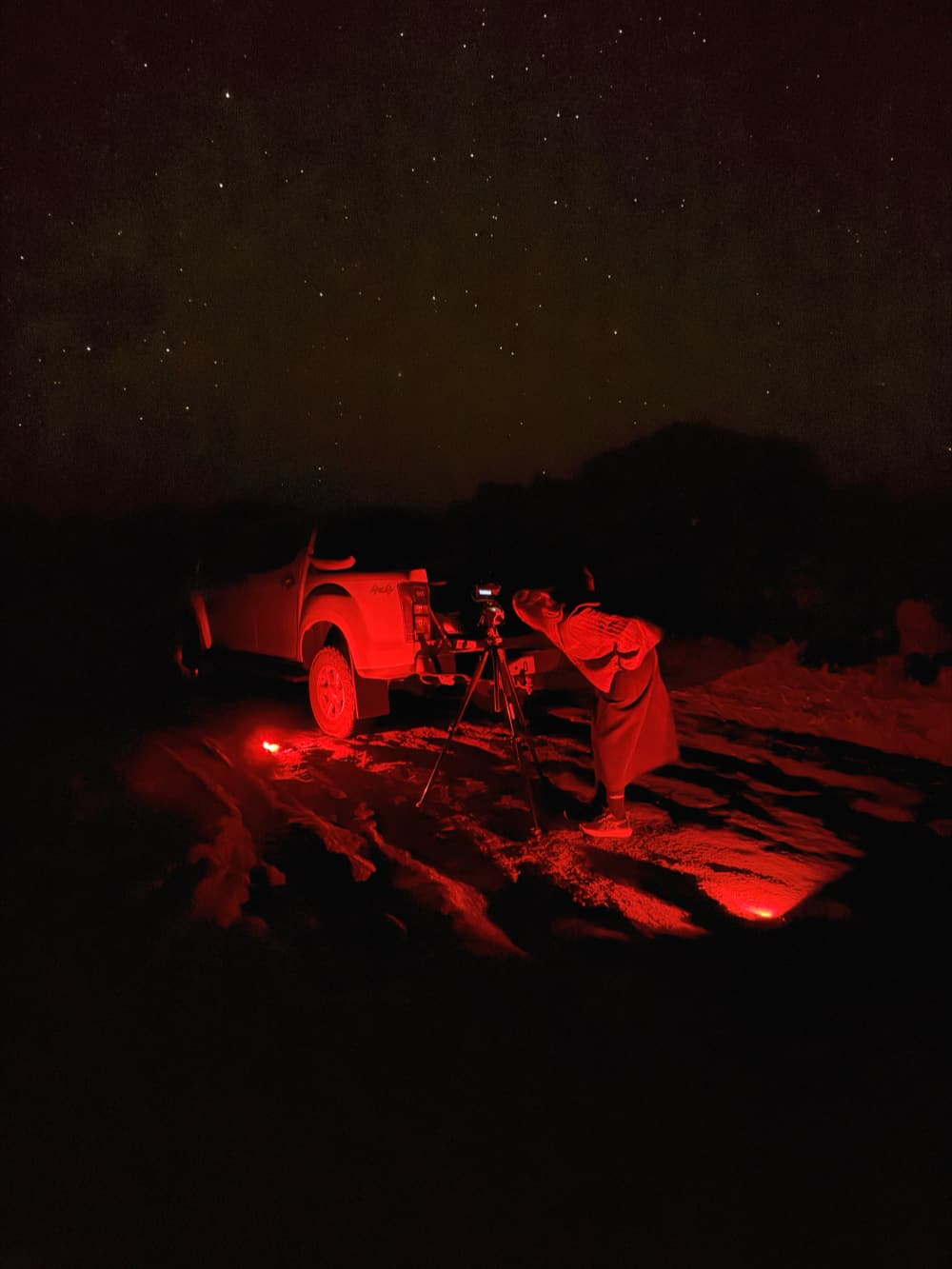
David and I are out photographing satellite trails while our kids fall asleep in the back of the ute. We quickly learn to use new gadgets that rotate counter to the Earth to register sharp stars on our camera sensors. Night after night, I see more in the night sky. The relationships I studied beneath the clouds amid Melbourne’s city lights are now clear—everything is in context.
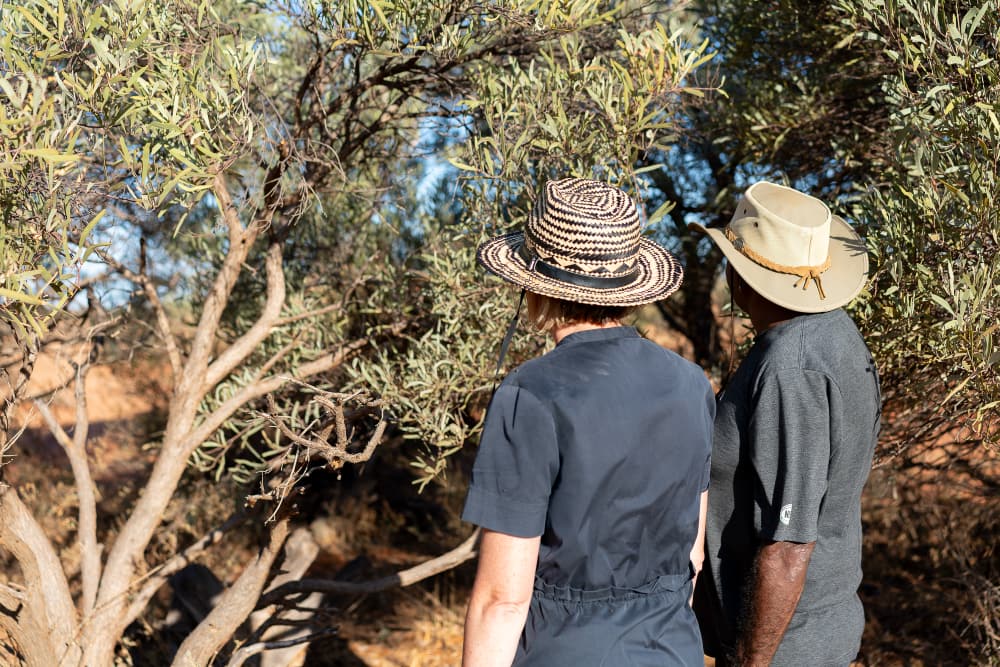
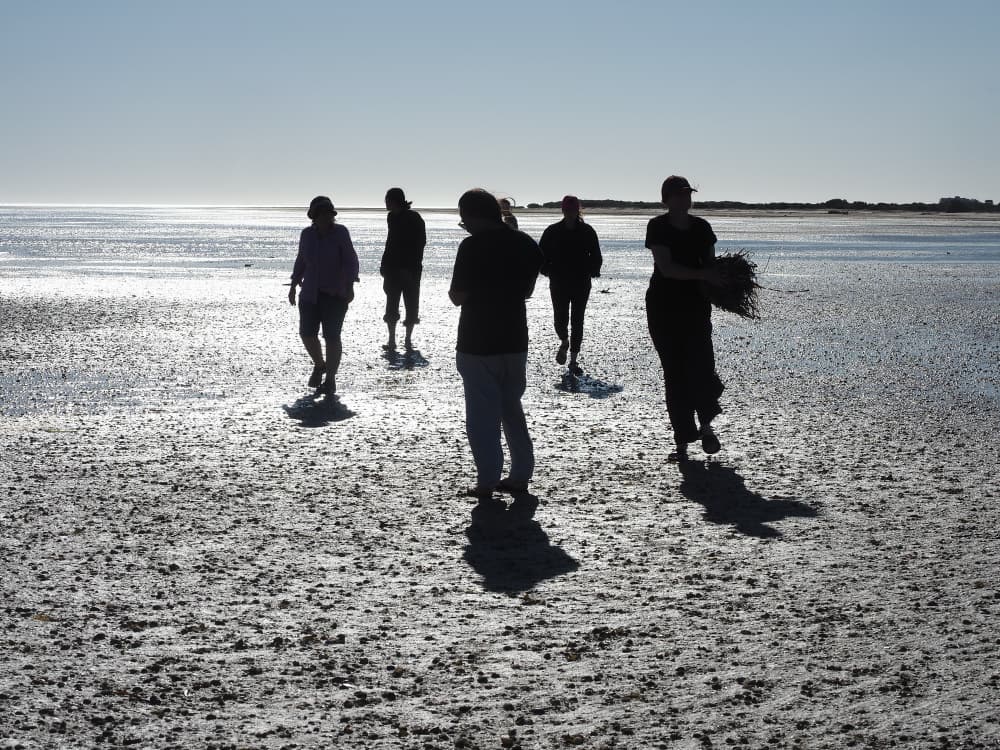
Traditional Owner Rennee Turner walks a small group of us out to the water’s edge and asks each of us to scrape a handful of sand. As we hold it, imbuing it with our scent, she talks about the place we stand. She calls out to her ancestors and invites us to introduce ourselves. Somewhat timidly, I call out, “Ngadha Linda,” and toss the sand into the water. I wait while everyone in our small group goes through the same process. Looking down, I notice a school of little silver fish swim up to our feet.
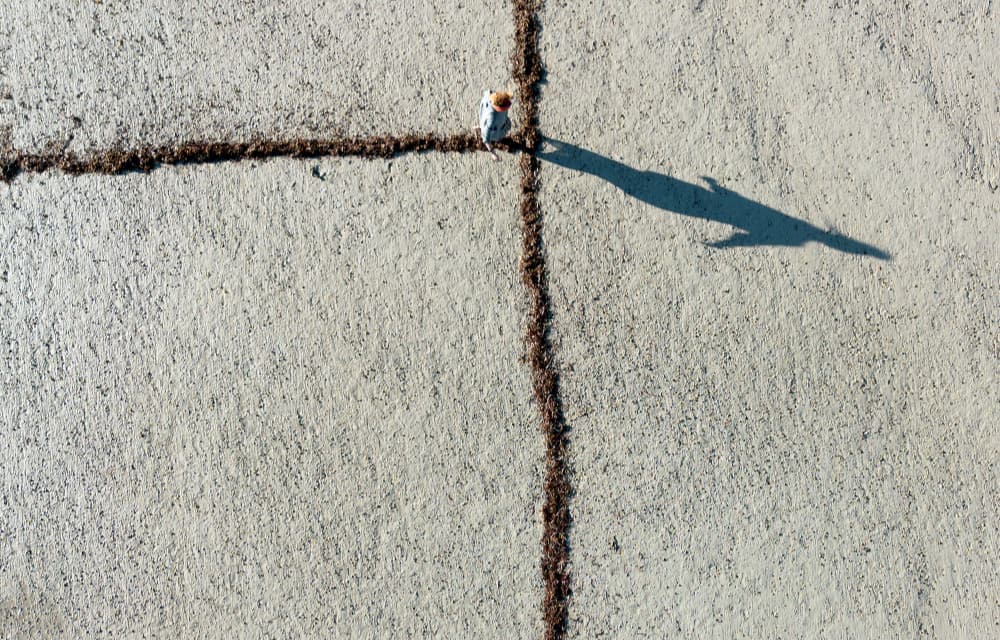
As the wind blows, we gather bundles of seagrass, wet them to give them weight, and lay them out in lines along the flats. We’re recreating the satellite trails that appear in the photographs I’ve pinned to the ground. More of us join in as the afternoon goes on.
As night falls, Rennee describes what she sees in the sky, explaining how the distant stars signal relationships here on Earth—conditions, cycles, seasons. Her stories weave cultural understandings. We all line up to see Saturn through her telescope. I interject with my gratitude and a few facts I’ve learned about Starlink satellites from the internet. She points at the sky with a laser that’s out of this world.
The trails we made are difficult to detect in the morning—just faint lines across the flats where the seagrass had been laid. The kids grab their fishing rods and cast them into a nearby channel. Suddenly, we find ourselves surrounded by water; the tide has come in.
—Linda Tegg